What Happens After You Register a Company in the UK?
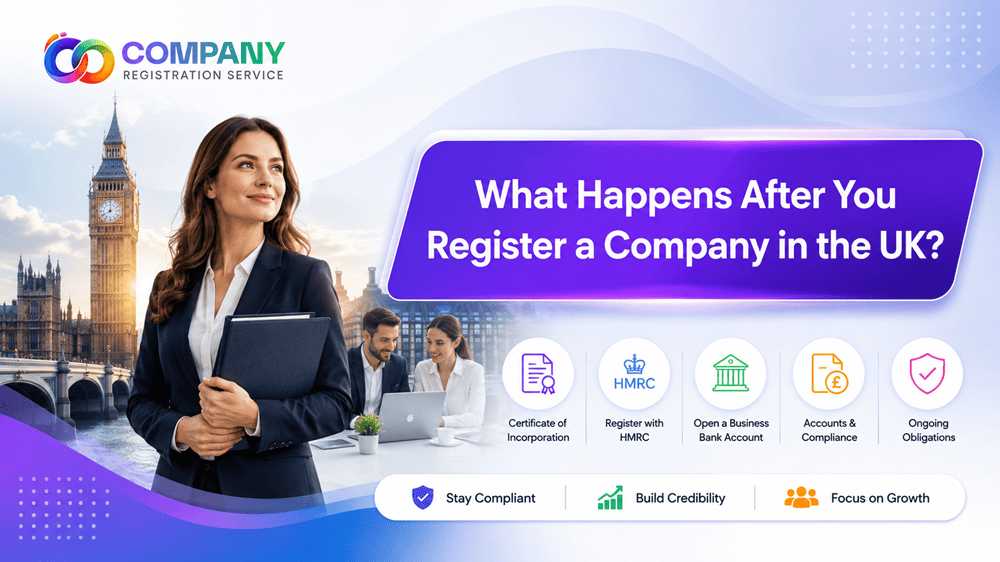
What Happens After You Register a Company in the UK?. Registering a company in the UK is a major milestone for any entrepreneur. However, many business owners think the process ends once Companies House issues the certificate. In reality, that is only the beginning. After UK company registration, several important legal, financial, and operational steps must follow to keep the business compliant and active.
At Company Registration Service, we regularly help founders understand what happens next so they don’t face penalties or confusion later. Moreover, whether you register a limited company in London, Manchester, Birmingham, or remotely from overseas, the post-registration process remains mostly the same across the UK.
Immediate Steps After Company Registration in the UK
Once your company gets incorporated, Companies House issues your Certificate of Incorporation. However, this document alone does not make your business fully operational.
Therefore, you must complete several important actions quickly.
1. Set Up a Business Bank Account
Firstly, you need a UK business bank account. Without it, you cannot properly separate personal and company finances.
Most banks will require:
- Certificate of Incorporation
- Company registration number
- Director identification
- Proof of address
- Business activity details
Moreover, some banks may ask for a business plan depending on your industry.
2. Register for Corporation Tax
Next, you must register your company for HMRC Corporation Tax within 3 months of starting business activity.
If you delay this step, HMRC may issue penalties. Therefore, it is very important to act quickly.
Additionally, you will receive a Unique Taxpayer Reference (UTR) number after registration.
3. Set Up PAYE (If You Hire Employees)
If your company hires staff or even pays yourself a salary as a director, you must register for PAYE (Pay As You Earn).
This allows you to:
- Process payroll legally
- Deduct income tax
- Pay National Insurance contributions
Moreover, even small companies often need PAYE from the start.
Ongoing Compliance Requirements in the UK
After registration, compliance becomes a continuous responsibility. Therefore, business owners must stay organised.
Annual Confirmation Statement
Every UK company must file a confirmation statement with Companies House once a year. This confirms that company details are still correct.
Failing to file on time may lead to penalties or company strike-off.
Annual Accounts Filing
Companies must also submit annual financial accounts to Companies House and HMRC.
These accounts show:
- Profit and loss
- Balance sheet
- Financial performance
Moreover, even if the company is inactive, accounts must still be submitted.
Key Post-Registration Tasks Overview
| Task | Deadline | Purpose |
|---|---|---|
| Business Bank Account Setup | Immediately after incorporation | Separate finances |
| Corporation Tax Registration | Within 3 months | HMRC compliance |
| PAYE Registration | Before hiring staff | Payroll processing |
| Confirmation Statement | Every 12 months | Update company info |
| Annual Accounts | Yearly | Financial reporting |
Therefore, staying organised helps avoid fines and compliance issues.
What Happens Operationally After Registration?
Once your company is registered, you can legally start trading. However, operational setup still takes time.
Branding and Business Identity
Firstly, you may need to set up:
- Company website
- Logo and branding
- Email addresses
- Business cards
- Marketing materials
Moreover, a strong brand identity helps build trust quickly in the UK market.
Contracts and Legal Agreements
Secondly, you should prepare legal documents such as:
- Client contracts
- Supplier agreements
- Terms and conditions
- Privacy policies (GDPR compliance)
Additionally, UK law requires data protection compliance if you collect customer data.
Accounting System Setup
Next, setting up an accounting system becomes essential. Many businesses use software like:
- QuickBooks
- Xero
- FreeAgent
Furthermore, keeping accurate financial records helps during tax filing and audits.
Taxes After Company Registration in the UK
Understanding UK tax structure is very important.
Corporation Tax
Companies must pay tax on profits. The current UK corporation tax rate depends on profit levels.
VAT Registration
If your turnover exceeds £90,000 (approx threshold), you must register for VAT.
However, some businesses register voluntarily to improve credibility.
Dividend Tax
If you take profits as dividends, you may also pay dividend tax depending on income levels.
Therefore, proper planning helps reduce tax mistakes.
Related Post:
» Business Opportunities in KSA 2026 Guide
» What Information Do You Need to Register a UK Company?
» Business Opportunities in Dubai 2026 Guide
» How to Search Company Name Availability in UK
» Business Opportunities in Oman 2026 Guide
Common Mistakes After UK Company Registration
Many new business owners make avoidable errors after incorporation.
Mistakes include:
- Ignoring HMRC deadlines
- Mixing personal and business finances
- Not filing annual accounts on time
- Forgetting VAT registration
- Poor bookkeeping practices
Moreover, these mistakes often lead to penalties or compliance stress.
Benefits of Proper Post-Registration Setup
When everything is set up correctly, businesses enjoy several advantages.
| Benefit | Explanation |
|---|---|
| Legal Compliance | Avoid penalties and issues |
| Financial Clarity | Better money management |
| Business Credibility | Stronger client trust |
| Growth Readiness | Easier scaling process |
| Tax Efficiency | Proper planning reduces costs |
Additionally, organised companies grow faster and face fewer regulatory issues.
Why Many Businesses Seek Professional Help
Although company registration seems simple, post-registration compliance is often more complex.
Therefore, many entrepreneurs work with services like Company Registration Service to handle:
- HMRC registration
- Accounting setup
- Bank account guidance
- Compliance filing
- Business structuring
Moreover, professional support reduces errors and saves time.
Conclusion
Registering a company in the UK is only the first step. After that, business owners must handle banking, taxation, compliance, accounting, and operational setup. Although it may feel overwhelming at first, each step becomes manageable with proper planning.
At Company Registration Service, we help entrepreneurs understand what comes next after incorporation so they stay compliant and confident. Because honestly, success in the UK market depends not only on registration but also on how well you manage what happens afterwards.
Social:
https://in.pinterest.com/pin/1085860160180325236
https://www.linkedin.com/feed/update/urn:li:share:7458825377876979712/


Comments
Post a Comment